Sunday, October 2, 2022

Let's Move!

Fast Llamas

I was watching The Amazing Race and a contestant said something that really caught my attention... she said, "Once I added the moves to what I had to remember, it was easier for me to recall".  Wow! That's so smart!  In QL we add "moves" to information we want to recall easily.  There is a mind body connection.  Move the body, move the mind!  Movement is critical to enhancing learning.  It keeps students alert and focused, increases the flow of blood to the brain, and primes the brain for memory associations.

Here are some ideas to try:
1. Act out vocabulary words with their bodies. This will give them a visual picture to remember their words.

2. Have the class clap out the syllables in the names of their classmates or their vocabulary words. 

3. Create a mantra to use at the beginning of class... have students create a clapping routine for it. 

4. Have students use an object such as a pencil and hold it in, under, over, next to, beside, or above their desk to act out prepositions.

5. Station Labs... break a worksheet into parts, have students rotate.

6. Mark a ladder on the floor with tape and have students ‘step’ up and down the ladder to practice their subtraction skills.

7. Use manipulatives to practice concepts.

8. Have your students pretend that they are the center rod of a globe. Have them show longitude, latitude, the equator, etc on their globes. For instance, if the USA is on their chests have them show where is Europe, Africa, or Australia are located.

9. Through movement, have students mimic the different states of matter; liquid, gas, and solid.  The choices are endless.

10. Vote with your feet! Some call it 4 corners.  Put a topic, decision, location, answer, political agenda, etc. on opposite sides of the room. Ask students to choose one side or the other in answer to a question. For example, if you’ve just completed a study of Greece, put Athens on one side and Sparta on the other. Have students stand under the sign of the community they want to live in. Tell them to be prepared to explain their choice.


11. Motion - create motions to help students remember content as they say it... 

12. Body Mnemonics - choose parts of the body to remember, the head, ears, nose, arms etc... like a Loci mnemonic where different areas of a house help you remember, use different areas of the body to help you remember.  Here is an example to remember the 8 keys of Excellence.

Your students want to move, orchestrate this energy to interact with your content, one another and with you.

Have a great week!

Sunday, September 25, 2022

 Hey Fast Llamas, 

This is a repost from 2019, but it's a good one and is reposted due to a coaching conversation I had with the Math coach on my campus.  It's good stuff and a good reminder of strategies... 

 
So far we have talked about Threshold and Strong Start strategies as students enter and we begin class.  
Now what?  How do we get to the learning as fast, efficiently and respectfully as possible?  My first year of teaching I realized quickly that I needed to find a way to get the students attention.  I started flicking the lights on and off.  It worked.  But, I am not sure how I feel about it.  I do know that since I wasn't a QL teacher yet, my overhead lights were always on, so flicking them "off" to get attention wasn't so bad. If I had continued that practice, (when I stopped using fluorescent lighting), that switching the lights "ON" to get their attention would of blinded the kids and would of seemed punishing.  By the time I was using lighting purposely, I had developed a better plan.  (thank goodness).  

The Call to Attention...
Like I mentioned above, what you use to call the students to attention is not a punishment, but a classroom management technique that simplifies your ability to get kids attention in a positive way and teaches kids self-regulating behaviors and guides them to autonomy.  (stay tuned for more on that in a minute).
There are lots of examples of Calls to Attention out there on the web and you may have one you like...  A teacher friend of mine simply says, "Hey"  and the kids say "Ho", another says, "Howdy" and the kids do the same.  Some teachers do a narrating countdown, ("you are quiet in 5, pencils down in 4, eyes on me in three, etc.") or simply hold a hand for "5". The important thing to do is practice it a lot, and hold that 100% compliance is happening by scanning the room.  If the kids know you are waiting and looking, it will be more effective.  Waiting and looking sends a message that you are serious and you expect them to comply.

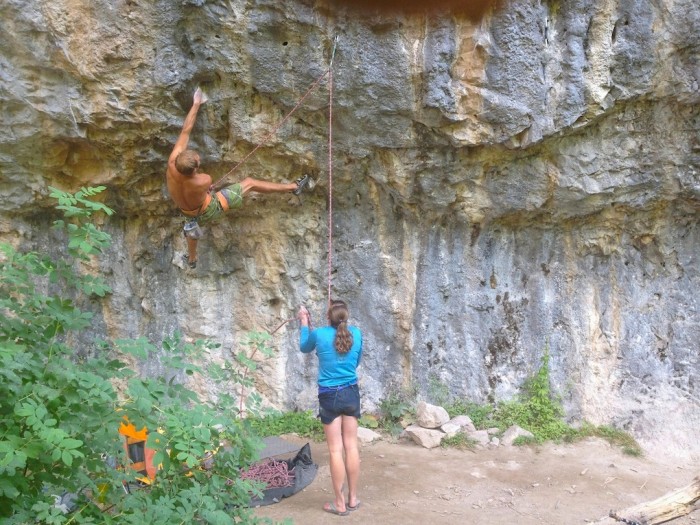
forrest and sarahIn my classroom, I used a modified rock climbing command protocol.  In the sport of rock climbing, “on belay” is the first climbing command used by a rope climbing team at the base of a climb. "Belaying" refers to actions used to keep tension on a climbing rope so that in case of mishap, a climber does not fall before being stopped by the rope. "On belay" is the voice command issued by your climbing partner to indicate they are ready to keep the tension of the rope as you climb, thereby ensuring safety of the climber. In my class, I used the metaphor that I was their belayer, holding their rope and supporting them as they climbed 8th grade science.  I believe they had more stock in saying it, since I took the time in a mini-lesson to explain what it meant to me and to them.  It was an effective call to attention. More on what it look, sounded and felt like below.

Change Their State:
To increase my ability to train students to self-regulate and change their state, I combined my call to attention with a kinesthetic state change.  I used SLANT first, which was started in KIPP schools, is used by Quantum Learning (where I learned it) and is mentioned in Doug Lemov's book, Teach Like a Champion.  I later switched to PLAN which is from Doug Curry's How to Train a Llama.  There is STAR too.  

Here are the three that I have seen and used:
Sit up                                            Sit up                                              Posture (sit up)
Lean forward                              Track the speaker                         Lean, look and listen
Ask and answer questions       Ask and answer questions          All things put down
Nod your head                            Respect others                              No talking
Talk to your teacher

As you can see, they are more alike than they are different.  I had success with SLANT and with PLAN.  (the reason for my switch was my entire building used PLAN, no big deal)

So, my call to attention looked, sounded and felt like this... 
(remember I  modified it for the classroom, true rock climbers will notice that the commands are reversed, but, it worked for the outcome I needed in the classroom)
Me:  "on belay
Kids:  "ready to climb"
Me: "climb on
Kids: "climbing"
Me: "Show me your PLAN"
Kids: would sit up, lean forward, put pencils down, and look at me
Me: scan the room and make corrections and praise and praise and praise

This took practice, on my part to continue using it with fidelity and never getting upset when I had to use it.  I was in control of the classroom behavior in a positive way.  Remember, everytime I used it, I was telling them that I was sending a message that I was there for them,  setting them up for success and they were climbing higher and higher!
I would also manage their behavior by calling to attention when I felt they were getting too loud... right as the volume would rise, I would call them back and either check for understanding or students could share their learning.  
I also would go to the SAME spot in my classroom to call them to attention.  By spring, I could walk to that spot and the volume would decrease automatically.  That's self-regulation folks and sets up kids with feelings of satisfaction and autonomy.  

Tips:
1.  Keep it simple - don't choose something that will cost time or not be something you will hold on to...
2.  Time is important and being quick is the goal... so don't hold kids 15 seconds longer than necessary just to prove you are in control...
3.  Use the fewest words as possible.  A call to attention means you don't have to say "shhh" or other words.  It is all you say.  Talking more steals away the satisfaction and autonomy students gain when they comply.  We are training kids to self-regulate, they need to know what it feels like...
4.  Practice with peers (this practice is called microteaching and doesn't it sound fancy?) your procedures to increase your economy of words.  The goal... talk less.


Here's quick video for guidance.

Saturday, September 17, 2022

Change

Fast Llamas,

Good morning!  I am up early today since I passed out on the couch last night before 9:00.  My husband woke me up and put me to bed. I think he was happy for me, since I rarely get to bed early.  But, this got me thinking, why, all of a sudden I am sleeping so early?  What is my mind and body telling me?  

This week I made a huge decision about my job.  I took an offer to leave my high school (and my position as an instructional coach) to join a team focusing on classroom behavioral management.  This team supports schools across the district and instead of supporting just one content department on campus, I am now supporting schools at all contents and levels.  I am leaving a great school with people who I love... whom I trust and will miss tremendously.  I feel like an idiot to leave, to leave a place with positive momentum, yet, I am pulled to this new opportunity. In a conversation about leaving, a very wise person told me "there was an itch there, lean into it".  I feel fear and guilt and excitement and joy... it's a weird emotion.  To say I am stressed is an understatement.  

Let's talk about stress, there are different kinds:

Healthy Stress - eustress is stress brought on by momentary decisions and life.  They rarely cause issues with health and most people learn to deal with these moments with good habits.  Waking up a little earlier to help get out the door on time in the morning, or choosing your outfit the night before, putting your keys and wallet in the same place every day, are all examples of little things we do to help aid in reducing feelings of stress.  We build resilience to this type of stress too, as we learn the "ins and outs" of tasks, what once felt stressful, now is routine.  

Acute Stress - When chosen, acute stress builds resilience too. When we choose to ride that roller coaster or go out on stage, we are making choices. This type of stress doesn't hurt our mind or body.  Imposed acute stress can lead to trauma, examples include living through a disaster, grief or illness. With time, the mind and body heal however, in the meantime, the body is vulnerable since the immune system is affected.

Chronic Stress - Both mild and severe stress impacts the mind and body due to the length of time involved.  The stress does not diminish, so the immune system doesn't have time to recover and inflammation never gets reduced.  The longer the stress, the longer it takes to recover if ever.  People under the influence of chronic stress exhibit changes in personality (grumpy, quick tempered to unengaged and quiet).  

According to Eric Jensen's research on stress and its impact on teaching, stress can lead to the following outcomes:

How Chronic Stress Impacts You and Your Students
Here are some of the evidence-based implications of chronic stress:
  • Chronically stressed teachers tend to have the poorest student outcomes, such as lower grades and frequent behavior problems.
  • Chronically stressed teachers have higher rates of sickness, absenteeism, and accelerated aging signals.
  • Chronically stressed teachers impact student achievement for months. For example, teachers’ depressive symptoms in the winter negatively predicted students’ spring mathematics achievement.
  • Students with weaker math achievement made greater gains in higher-quality classrooms with less depressed teachers.
Jensen goes on to say...

"Our brain has two “filters” over which you have some control. The two are 1) the perception of relevancy of the situation/event and 2) your sense of control over the situation/event (coping tools).

You could become so cold-hearted that you make everything irrelevant to you. Or, you could develop such extensive time-off resources (key contacts, valet, a private jet to fly you to the Bahamas, a masseuse, etc.) that you can handle most stressors pretty well. In short, relevance and perceived control are the two biggest “brain filters” that determine whether or not you’ll feel stressed.

This means that thinking your students, the principal, or your students’ parents are stressing you out is misplaced blame. They don’t stress you out. Your students do not have superpowers to do that. You stress you out (Godoy, Rossignoli, Delfino-Pereira, Garcia-Cairasco, & de Lima Umeoka, 2018).

So, the real reason for this blog this week is to talk about SKILLs to deal with how you are feeling.  The above information is kind of the bad news, let's talk about the good news.  When I shifted from the thinking of dealing with emotions and stress by pushing them down and suppressing them, to pushing through them and expressing them (in healthy ways), my mental and physical health improved.  I remember a particular stressful period in my life when we moved across the state, I told my husband, "just let me cry, don't try to make it better or easier, I just need to get it out and release these feelings,"
A lot of advice comes in the form of "setting boundaries" of the time teachers devote to the work they do.  But, it is challenging to put down the work (that has to get done) until later.  Because "later" shows up with even more to do.  Building a skill set of how to deal with the work and the stress that comes with it, is helpful.  

Here's four things you can do (so you don't end up crying) to deal and build resilience to stressful situations.
Mindfulness
I know what you are thinking?  You are asking me to meditate? Isn't that kind of mystical stuff?  I thought so too, but I started dabbling into it a few years ago.  I have tried different apps, Apple currently is offering one free year of their app Balance and I like Calm, but with both, they required subscriptions to unlock packages.  After listening to Brene Browns podcast interview of Dr. Amishi Jha, though I got more interested.  I read this:
And am sold on meditative practices.  I meditate for about 12 minutes a day... the goal is 20 minutes and someday I will get there.  This week was super stressful for me, but, I feel like my "bounce back" to normalcy is quicker than in the past.  After meditating, I feel sharper and clearer.  I don't use music, narration or chimes.  I don't have a special rug or room,  I just sit and focus on the breath. So, simple it's mind blowing.

Gratitude Practices
Do you set time aside each day to reflect on the blessings of your life?  I started practicing gratitude with a daily gratitude journal about 2 years ago.  In my daily journal,  I reflect on things I am grateful for and things I am looking forward to, you could add or change it to things your are optimistic about.  People who stop to reflect on these ideas have improved health, high levels of life and work satisfaction and lower levels of depression and stress.  Simply reflecting, noticing and appreciating the positive things is your life is a game changer in terms of managing your stress levels.  It has changed me as well.  I spend a lot of time noticing things that I can be grateful while I go about my day.  Somethings are small, like a good cup of coffee, some things meaningful, such as laughter or trust, some things are life changing, like the health of my parents and children.

Diet
While the first two stress management tools I find easy to practice, my diet could be improved.  Why I have such a difficult time taking a daily vitamin is beyond me, but I struggle.  I also tend to snack on carbs late in the evening.  Every day I proposed to not eat past 6 pm... each day I struggle.  So, for me this is a challenge... but, I work on it each day.  I have to be careful too, there was a time that I dealt with stress by depriving my body of food, getting down to near 110 pounds at my lightest at one point in my life. On a particular stressful day this past week I didn't eat at all. So I am mindful of both extremes.  
Eric Jensen suggests:
Change what you eat, and you change both your body and mind. To do this, pick one micro 60-second or less habit. For example, limit yourself to only one drink (soft drink, beer, or wine) a day. After a month, limit yourself to one a week. Or another example, you can limit yourself to one sweet item a day. Then after a month, limit yourself to just one a week. You can make the changes that will change your life. Start today.

Exercize
Do people feel better when they exercise? Of course they do!  Do I know I should exercise each day? yes! Does that mean I do each day? Nope!  Like diet, I struggle with this too.  I used to run, but it hurts my body too much, so I walk about 2 to 3 miles a day.  Making it a daily habit takes effort... like all things, I need to make it important to myself.  

Teaching is stressful because it is important work.  But, like it is said in the safety training before each airplane flight.  You put the oxygen mask on yourself FIRST, before you help others who cannot help themselves.  Be sure you are taking care of yourself first. But, this takes effort and a shift in your perspective and actions.  But, with all things, effort creates ability. The work is worth it.


Sunday, September 11, 2022

Fiddling on the Roof!

Fast Llamas,

I was watching a tv show and they played "Sunrise, Sunset", from the Broadway play and eventual movie Fiddler on the Roof.  If you have never seen the movie, here is a clip - you really just need to watch minute 1.


My parents had this soundtrack album, and we played it a lot. My parents always had music playing in the house, so when I heard the song on the show I was watching it brought back memories.  But, one thing I never understood was the title.  I always thought the "Fiddler" was just a figment of the lead character, named Tevye's, imagination.  Upon listening again, I realized, the Fiddler represented the people of the village, trying to scratch out a tune (a life) all the while not breaking their necks!  All the while balancing troubles with the beauty of life.  How did the villagers maintain this balance?  Tevye then shouts... Tradition!  a great song (this is musical theater after all) of tradition comes in... 
Okay before we go much farther... I am a fan of musical theater... many showtunes showed up in my wedding music. But, as always, I digress...

Thinking about Fiddler on the Roof, made me think of teaching. Teachers are in state of balancing all the demands - classroom management, content delivery, culture, character, etc. We have a lot of balls in the air that we juggle. And sometimes it feels like we are juggling while standing on the roof!  But, just like the musical; how do we keep our balance?  Why, yes, with traditions too.
Today, we are talking about traditions... how how great they are for you, your classroom and your students.  

We have talked before in this blog about the importance of systems in your classroom.  Doug Curry writes his entire "How to Train a Llama" based on it.  Systems or routines if you want to call them that too, help students understand how your class runs.  The more habitualized they become the better for you and for your students.  

Systems and routines are nice, but how about creating them as a tradition? Traditions upgrade routines by making them fun, positive and meaningful.  Traditions help create connections and a sense of belonging to you, the class, and your content.  Clear traditions on how class runs helps kids feel safe.  And, feeling safe supports learning.  Traditions include systematic operations such as-  how we enter, how we leave, how we ask questions, how we get help, how we get supplies, how we turn in materials, how we use our laptops, how we take notes, how we transition from one task to another, what do we do while teacher is talking, what we do when a classmate is talking...
Do you get the idea?  
Traditions also dive deeper to support culture and create what we call Home Court Advantage.  Traditions include how to celebrate birthdays, students activities (teams and clubs) and personal celebrations (new sister was born, vacations, etc)

The brain craves clean beginnings and clean endings, so having an official opening tradition  helps change state as students enter your room, sending a message to your students, that "now it is time to learn _______________".  That's a win for everyone.

Let's dive deeper into Opening Traditions.
Remember, "everything speaks", what messages do you want your students to receive about your class, your subject and learning?  Being purposeful about how you start class puts you in control of that message. Also remember, your "warm-up" question is not an opening tradition, it can be a part of it, but it is not the whole of it.  
Ask yourself - 
  • What do you do now? How do you start class? What happens in the first 5 or 10 minutes? Why?
  • What do my students expect to see, hear, and do when they enter the room?
  • Remember, be clear on what, why and how.
  • How will my students feel at the start of class?
  • How will I orchestrate the opening class tradition to lead to desired outcomes? 
  • Consider time limits, student involvement and other opportunities.
  • What music, supplies, content, anchor charts or other tasks (attendance) to consider?
What are some examples of Opening Traditions?  
  • a mantra - 
    • Teacher says..."It's our time" Students say "and we are ready to learn",
    • Teacher says, "Why are we here?" Students say,  "to learn", Teacher -  "What's it gonna take?" Students - "100% Effort!"
    • Teacher says "this is..." Students say "Sparta!"
  • an opening song that is played for about a minute to change state - Could be anything you like, but something lively
  • a chant  - one year, we chanted the parts of an atom every day... this could be any content that is hard to remember!
During class? - how about creating a class name and having a class mascot?  Kids at tables?  Could they create a table name and mascot?  sure thing!  We often number our tables, how about adding name the kids make up?

What about ending the class?  How about that clear ending?  We need that too, and yes it is NOT the exit ticket, though it may be a part of it, it is not the whole of it.
One year, my students started getting up and putting away their journals before class was let out.  They started putting away earlier and earlier.  So I created an "ending tradition" that looked, sounded and felt like this... 
1. I introduced the "7's".  The sevens is a clapping routine... see video of my kid demonstrating them... of course they can be changed to whatever you want... but they follow a pattern of 7's. This can be whatever you want it to be!  But the point is, I changed their state... right after the 7's, we answered an exit ticket which we called "THE BIG QUESTION",  a great way to review and recap the day's lesson.

Kids loved it and problem solved.  
Ending class can also include mantras.  One teacher I know would say, "Mischief" and the kids would say, "Managed", another teacher had kids tap a poster by the door and say, "I am responsible to everything I say and do".

Let's talk implementation.  Masterful teachers are able to match strategies with their audience.  So, traditions are imparted organically.  No way I am gonna make my kids say a mantra the first weeks of school.  We have to build rapport first.  As the kids know you and trust you, then you can up the gradient of risk.  That's right, risk, it is risky for a kid to put themselves out there and be silly and fun sometimes.  My ending tradition worked because it was about October, when the problem surfaced.  So, the kids knew me and knew each other well enough to clap and snap together.  What age were these kids?  8th grade... if that helps.  And they really loved it because they could stand and be loud if they wanted.  If we didn't do the tradition (we were taking a test for example) kids would say they missed it.

Here are some helpful hints:
1. Explain the why 
2. Have a "power of positive thinking" tone when introducing traditions
3.  Have high expectations
    - rehearse it
    - do overs 
    - not going away
4. Make it fun
5. Make it relevant
6. Make it quick 
7. Use visuals 

Reflect on how your class is shaping up... it's still early in the school year to establish those "how the class runs" traditions... be thinking of diving deeper as you get to know the kids and develop opening and closing ones too.  Traditions help keep our balance, without them, we would be as shaky as a fiddler on the roof!

Sunday, September 4, 2022

Trim Tabs and the Your Power Within

Fast Llamas,


I have been running across articles and blogs about reflective practices and how they can inform the development of relationships with your students and fellow teachers.  I really like this, because we have talked about the importance of relationships and how they can create academic growth.  I love saying that relationships that foster curiosity, joy and belonging are the vehicle to move students success. Achievement comes along for the ride in the form of deep learning and a change in student attitudes about their own learning and your content.  Now it seems, there is more conversations about the specificity of "how" to create these relationships.  Say out loud right now, "It begins with me".  (it's okay if people look at you funny, it's part of the journey)

In my own teaching story, it was when I became more reflective (knew thyself) about my own teaching practices that I was able to see a shift in my students abilities.  I became a happier teacher when I shifted from my "teaching" to my "student's learning".  Creativity bloomed; engagement increased; and a more challenging classroom emerged.  

To get started on your reflection ask yourself these questions:

1.  Do you focus on the learning as your design your lessons?  Spending more time on the learning, rather than your teaching?  

2.  Do you focus on individual student experiences, rather than the class' experience with your lesson?  The whole class experience is important, too, but, how well do you know students in order to understand their individual experience?  Do you know the flyers and the kids who need interventions?

3.  How will you handle negative comments about your students  and their abilities?  (on the clock face we discussed last week, as "whoa, don't label). What words will you use when colleagues begin to describe their inabilities?

4. How dialed in are you to ensuring you are making a connection with students? How do you know they leave your class still thinking about the lesson? How long will they carry it with them? Not just content, but how they felt in class today?

5. What's your plan for how you speak to students? What is your body language?

6. How do you get to know your students?

7. Once you know your students, how will you use this information to teach them?

We focus on out content and how we will deliver it, but there is a common thread here. It begins and ends with relationships. Create real connections and a sense of belonging and watch your kids succeed.

Sunday, August 28, 2022

Fast Llamas Run Together

Fast Llamas,


It's a new year and the energy and excitement at my campus is palpable.  There is also optimism and hope.  It is an exciting place to be right now.  I see it in teachers faces, administrator's and most importantly, our students.  

I want this energy to continue, but it takes several factors to keep it alive.  Let's dive deeper.  

A while ago, I presented this idea of 12 essential strategies to build relationships with students and create a positive shift in achievement.  

Here they are:


What is especially cool about this graphic is that is actually a mnemonic device called "clock face".  Each strategy rises in effect size (the actual effect on growth of students, .4 or higher is an effective strategy) and it is easy to remember because there is a story attached to each one.  This particular clock face was adapted from the work of Wes Kieschnick, who delivered it during Model Schools Conference. It stuck with me and I love when I see this taped to a teacher's desk as a reminder.  

So, my focus has always been student achievement and will remain so... and I believe in the Fast Llama Herd. Which I think of as a group of llamas (teachers!) all running in a herd, in the same direction, in step with one another and aligned with a belief that together the herd is stronger than one llama alone.  I made the connection to the Fast Llama Herd and Collective Teacher Efficacy a while ago, but it wasn't until this summer that I made a real shift in perspective.  

First off, what is collective teacher efficacy?  Collective teacher efficacy is the belief that teachers can more positively impact the learning of their students if they work as a team. Each word of the term is important. 
“Collective” refers to the power of groups of teachers over individual teachers. 
“Teacher” centers the expertise of classroom practitioners, rather than school leaders or outside educators. 
“Efficacy” highlights the importance of teacher beliefs to improve student outcomes.
This concept is the work of Albert Bandura, which demonstrated that teams believing in their potential led to better results.

That shift in perspective for me was the idea that we focus on building student relationships (and rightly so) but we also need to cultivate our relationships with one another.  We already do a pretty good job at fellowship within our teams.  We eat together, we celebrate each other in social ways and we know about each others families.  But, do we apply "clock face" strategies in collegiate ways in terms of our practices?  On the clock face, the last important strategy is Belief - that is collective teacher efficacy... do we really believe in each other abilities?  and if we don't, what are we doing about it?  

Let's break down the clock face, but this time, focus on teachers.
12:00 - High Expectations - have high expectations of each other... let's not wallow in mediocrity, energy is important, and when you feel slumpy, I will build you up.
11:00 - Perception - I see you as a 10 or an 11, you are a capable and impressive educator.
10:00 - Connection - I know you and your classroom.  We root for each other.
9:00 - Innovation - we work together to create the best activities and strong pedagogy.
8:00 - Practices - we work together and practice with one another.  I watch you teach, you watch me - feedback follows.
7:00 - Goals - we set audacious goals for our students and ourselves.
6:00 - Whoa, Don't Label - I won't let you use derogatory labels for your students, and you won't let me.  We speak positively about our jobs.
5:00 - Creativity - we realize that when we are taking care of each other, creativity flourishes in positive supportive environments.
4:00 - Motivation - I keep you motivated and you keep me motivated.
3:00 - Clarity - we are clear in our goals, what we want to achieve and where we want to be.  We focus on being clear with students. We set each other up for success.
2:00 - Trust - we trust one another and our abilities to teach well.  I trust you with my students and vice versa.  I also know that my inner fears are understood by you and you see me.  
1:00 - Belief - the Collective Teacher Efficacy is strong with us - Student Achievement follows suit.  

As we move through the year, let's reflect back on this time.  When our energy is high, goals are fresh and we have a renewed spirit about our jobs as educators.  We make our school whatever we want it to be, same for our classrooms, but we cannot do it alone.  We need the collective, we need fellow fast llamas to keep us going.  I am so optimistic for the new year... let's keep it going! 


Sources:
https://bit.ly/3RbHJh8

Sunday, May 22, 2022

Environment

Fast Llamas,

A repost from 2019, but, as we wind down and clean up for the summer, use this time to think about the fall semester and dreams for your classroom.

I was walking in HEB yesterday and realized they have an entire section devoted to organization and cleaning in their "seasonal section". This got me thinking that the new year is for getting organized and do that "Spring Cleaning"! How does that apply to us at school?

So let's talk about your classroom. Let's change that thinking to an "environment". Brain based education studies note that the brain works best when it is not under stress. You release more dopamine and thus retain more information when don't feel fear or anxiety. So, focus on making your classroom aesthetically pleasing. I use table lamp and turn off the fluorescent lights. Once you have taught in a
room lit this way, you don't want to go back. It is very easy on the eyes. Doing any spring cleaning at home and are changing out lamps? Bring your old ones to school! When I was teaching at Spillane, I had a huge classroom (I am not bragging, lol). It was windowless, so it took quite a bit of lamps to
get it lit the best for my students. It took years of collecting lamps from friends, from discount stores and garage sales. So, let your collecting begin. Also, I got my first period to turn on the lamps for me... they liked it.
Consider adding plants. Plants serve two purposes, one, plants release oxygen and filter out pollutants, second, plants are pleasing and calming.
Now for the walls... When I began teaching, I put up every poster I could find. Free posters from NASA, (they will give you any if you ask), posters I purchased and posters I created. They were everywhere. Now this is amazing that I admit this, since I went to college to study education during the
heyday of Madeline Hunter. Hunter was the be all, end all of education during this time. She was the guru. And, she was good. I am still referring to her. Anyway, Madeline Hunter, said, your walls should be blank, with bursting and overflowing cabinets. In other words, only put the posters out that you are using at the moment, then put them away when the unit is done. So, be purposeful about your posters.
As the year progresses, add posters, remove posters, but keep what "icon poster and/or anchor charts" of specific info you want to keep on the forefront of the students minds. On these posters are items that I want to continue to recap and review with students.
Another educational strategist that I studied in college, who still speaks to me is Harry Wong. One of his suggestions is to put on a bulletin board a timeline of yourself. Start with a baby picture, definitely one of the age of the kids you teach, a high school or college, husband, etc. A story of your
life. Kids love it and you will see them looking at them. It's just another way to make a connection with them. And that's what "setting the stage" is all about, making the kids feel invited into your learning environment, establishing a relationship with them. Then, once you have captured them, then the learning can begin.