Sunday, October 13, 2019

Fast Llamas Know Their Why


Fast Llamas,

I love this video, Percy and I showed it to students last year when we taught them the 8 Keys of Excellence and the Line... I hope you love it too.  It shows the importance of knowing your "Why".
Knowing your why is a reflective practice that can really change the game for us as educators. Over the weekend, I saw two meme's that stuck with me.  One talked about the need to stop thinking that teachers need to be "fixed", instead, they should be supported, encouraged, inspired and appreciated. Dr. Brad Johnson (who wrote the meme) is an author of several books, including Learning on Your Feet: Incorporating Physical Activity into the K-8 Classroom (this sounds interesting), & What Schools Don't Teach: 20 Ways to Help Students Excel in School and in Life.  Dr. Johnson"s latest book, Putting Teacher's First co-authored with Todd Whitaker was just released.  His twitter page is worth following as is Todd Whitaker (more from him in a second). 
   

I love these as they are foundational beliefs for me.  Wes Kieschnick talks about the need to stop saying that education is broken. In both his Models Schools Conference Keynote speech and his book, Bold School, he is passionate to say that public education is not broken.  
Teachers have the ability to move mountains with kids, but, we have to work together, support one another and help one another.  The fast llama herd is there to support each other when we slow down.  Not only do we support each other when we feel slow, but, we also are there to celebrate the victories too.  This goes along with John Hattie's finding in his research that the number one strategy to move the needle, affect change and growth in students with the idea of the Collective Teacher Efficacy fed by the knowledge of their impact in schools.  The collective knowledge and skills present at Labay is amazing and excellence is all around us.  Hattie stresses the idea of "know they impact".  
Teaching is important and no program is more important than the teacher.  It's about people, not programs and the best PD can often be the teacher down the hall.  And we should lean on and rely on each other for assistance, collaboration and moral support as much and as often as possible.  We share our expertise with one another, know our impact and change the learning lives of our students.
I am reading the book, 75 Ways to Be a Better Teacher Tomorrow by Annette Breaux and Todd Whitaker.  This book was handed out to new teachers and it is a quick read with each chapter 2 - 3 pages.  Today, I am focusing on idea #15, Post a Simple Sign Telling Why You're a Teacher.  Andy Abbott and I were talking about this the other day, low and behold, it's already a thing...

It looks, sounds and feels like this... 

Make a sign that says, "I'm a teacher because..." and then list the reasons.
Make the sign fairly large and post it in the room for all to see.  It will remind you, every day, of why you are here and why you do what you do. 
Here's an example from the book:

I am a Teacher Because...
1.  I love my students.
2.  I love to help people achieve their goals.
3.  I believe that all of my students are talented.  It is a privilege to help students   
     discover their unique talents
4.  I believe that all of my students have amazing potential. It is a privilege to help all 
     students realize their potential.
5.  I feel there is no more important profession in the world.
6.  I love learning from my students.
7.  Teaching is fun for me!

Consider placing a duplicate sign outside your door.   I am thinking this would be a great addition to our teacher Bio's we already have posted.  Others will stop by and read it and you will inspire others.  Administrators will read it as well as well as guests in our building.  Proudly proclaim your love of teaching and post it for all to see.  

We are shifting our mindset in our thinking. This takes effort.  Everytime we send a positive thought across our neural pathways, we make our positive thoughts and actions stronger and stronger.  This thinking creates real change.  The first step is belief.


References:

Breaux, A. L., & Whitaker, T. (2019). 75 Ways to be a better teacher tomorrow: with less stress and quick success. New York: Routledge.
By. (n.d.). John Hattie. Retrieved from https://visible-learning.org/john-hattie/.
Kieschnick, W., & Casap, J. (2017). Bold school: old school wisdom new school technologies = blended learning that works. Rexford, NY: International Center for Leadership in Education.
Breaux, A. L., & Whitaker, T. (2019). 75 Ways to Be a Better Teacher Tomorrow: with Less Stress and Quick Success. New York: Routledge.By. (n.d.). 

John Hattie. Retrieved from https://visible-learning.org/john-hattie/.Kieschnick, W., & Casap, J. (2017). 

Bold school: Old School Wisdom + New School Technologies = Blended Learning that Works. Rexford, NY: International Center for Leadership in Education.

Breaux, A. L., & Whitaker, T. (2019). 75 Ways to be a better teacher tomorrow: with less stress and quick success. New York: Routledge.
By. (n.d.). John Hattie. Retrieved from https://visible-learning.org/john-hattie/.
Kieschnick, W., & Casap, J. (2017). Bold school: old school wisdom new school technologies = blended learning that works. Rexford, NY: International Center for Leadership in Education.

Sunday, October 6, 2019

Level up Planning - The Fast Llama Way


Fast Llama's,

Is it me or is the school year flying by?  We are heading into DPM time already!  
This past week I got a pedagogical infusion with face to face training with Pete Hall.  If you ever have an opportunity to hear him, he is simply amazing, real and intentional.  He got me thinking about planning and the "thinking about the doing".  This is an important moment for me as I have been struggling with the backwards planning process that Donna Pahmiyer advocates.  Her process is a good one, very intentional and grounded in the research.  (backwards planning shows up in the literature a lot, trust me).  
When the science department was spoiled with what we called the "war room", a room completely ours for planning, the process worked really well.  However, that room is gone and I tried and (have failed) to continue the process with large paper and markers... it was a whole thing.  We always try to bring our best and have the best intentions, but, physically it became impossible. However, what we learned from the backwards planning process (after reflection, more on this in a minute), is:

1. it's important to know what mastery and success looks like
2. it's important to know what the TEKS really say and what experiences students have with them
3. it's important to know what we are teaching everyday and how it aligns to what is assessed
4.  it's not teaching to the test when we are intentional to the exposure students are getting daily (this was the toughest one to accept)
5.  planning is important because it allows us to think deeper about the learning and most importantly, about the doing

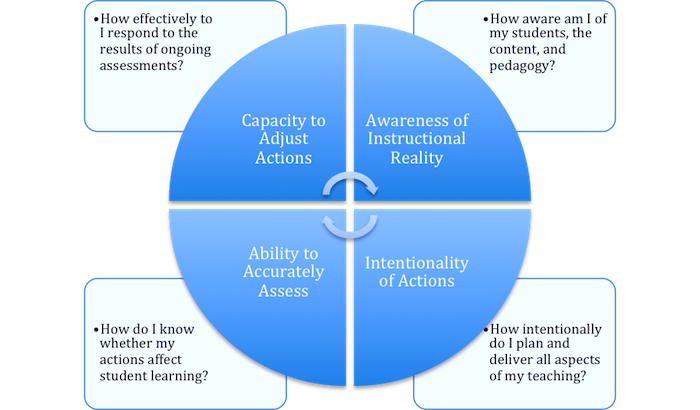
One of my favorite colleagues to discuss "the work" with is Melissa Bustos.  I do believe I like talking with her about teaching practices because she is reflective.  John Dewey (our old friend) said, "We do not learn from experience... we learn from reflecting on experience.”  And reflecting on our teaching practice is extremely important and what separates, what Pete Hall calls the "unaware", "conscious", & "action" teacher to the "refined" teacher on his reflective continuum.  (Unaware just means you don't know, it doesn't mean you are incapable of knowing, for example, I am unaware about how to artfully carve a pumpkin, but I can learn and practice and perhaps become an expert if I put in effort to the task) 

Here is Hall's Reflective Cycle:  


"If you don’t think, you don’t learn. It is the ongoing reflection by a teacher about their practice that results in improvement. Teachers who don’t regularly reflect risk stagnation and thus miss opportunities to engage and teach their students at higher levels." David Perkins.  
https://aplusala.org/best-practices-center/2018/12/14/helping-teachers-at-every-stage-build-their-capacity-to-reflect/

On Friday, Melissa and I hashed out a new plan to put Pahmiyer's  training into place in more intentional and practical ways that work for us at Labay.  "Her ideas are good, I get it", Melissa said, telling the first year teacher on our team, "you are learning a lot today."  
It's the planning that is the real work.  Teaching is actually quite easy, it's figuring out what to say, what to do, how to assess, how to dive deeper, how to extend, how to teach success, etc., that makes the work we do both rewarding and exhausting.  This reflection and planning is what separates excellence with mediocrity. 

So, my strategy to offer to you for tonight's motivation is to put reflection into practice.  Start a reflective journal on your teaching practices, like the one I created when I was starting with more purpose and intentionality using Quantum Learning strategies.  I wrote each day on the "QL" strategies I was putting in to play in my lesson plans.  The planning morphed into using my content to provide SEL, multicultural and character lessons into my daily interactions with students.  Reflective journaling made the difference that year in  my growth of putting into play more QL.  Teaching became exciting as I was looking for ways to level up my lessons.  It took a little effort, but the pay off was big.  I didn't realize it at the time that I was being reflective, I was simply writing down what I was doing to think about new ideas and realistically to remember to do it again the next year.  It was the difference between mediocrity and what I might dare say excellence.  


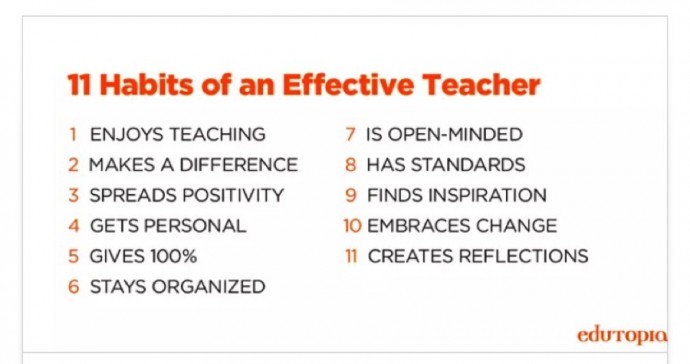
I found this on Edutopia, let's rename this 11 Habits of a Fast Llama! Check out #11.  


Keep running fast llamas!
For more information about Pete Hall research, check out this presentation...
https://www.sccharterschools.org/assets/2016Conference/growingyourreflectionprocess.pdf

Pete's Books:


Sunday, September 29, 2019

Getting to Learning Fast


Hey Fast Llamas!

So far we have talked about Threshold and Strong Start strategies as students enter and we begin class.  
Now what?  How do we get to the learning as fast, efficiently and respectfully as possible?  My first year of teaching I realized quickly that I needed to find a way to get the students attention.  I started flicking the lights on and off.  It worked.  But, I am not sure how I feel about it.  I do know that since I wasn't a QL teacher yet, my overhead lights were always on, so flicking them "off" to get attention wasn't so bad. If I had continued that practice, (when I stopped using fluorescent lighting), that switching the lights "ON" to get their attention would of blinded the kids and would of seemed punishing.  By the time I was using lighting purposely, I had developed a better plan.  (thank goodness).  

The Call to Attention...
Like I mentioned above, what you use to call the students to attention is not a punishment, but a classroom management technique that simplifies your ability to get kids attention in a positive way and teaches kids self-regulating behaviors and guides them to autonomy.  (stay tuned for more on that in a minute).
There are lots of examples of Calls to Attention out there on the web and you may have one you like...  Jessica Hedges simply says, "Hey"  and the kids say "Ho", Emily Smith says, "Howdy" and the kids do the same.  Some teachers do a narrating countdown, ("you are quiet in 5, pencils down in 4, eyes on me in three, etc.") or simply hold a hand for "5". The important thing to do is practice it a lot, and hold that 100% compliance is happening by scanning the room.  If the kids know you are waiting and looking, it will be more effective.  

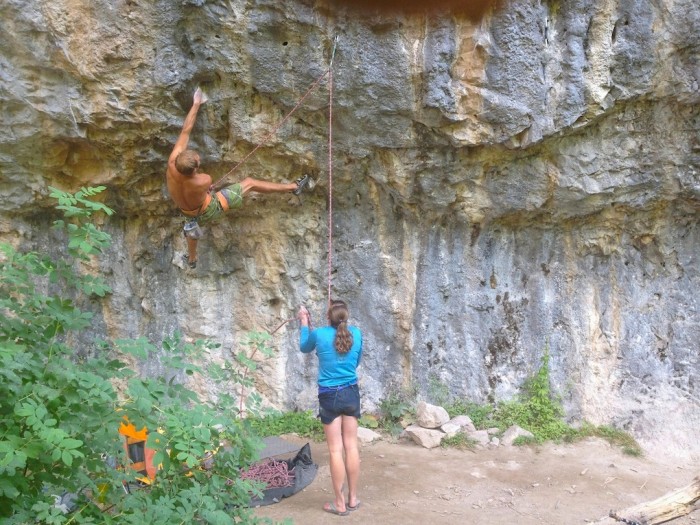
forrest and sarahIn my classroom, I used a modified rock climbing command protocol.  I used the metaphor that I was their belayer, holding their rope and supporting them as they climbed 8th grade science.  I believe they had more stock in saying it, since I took the time in a mini-lesson to explain what it meant to me and to them.  It was an effective call to attention. 


Change Their State:
To increase my ability to train students to self-regulate and change their state, I combined my call to attention with a kinesthetic state change.  I used SLANT first, which was started in KIPP schools, is used by Quantum Learning (where I learned it) and is mentioned in Doug Lemov's book, Teach Like a Champion.  I later switched to PLAN which is from Doug Curry's How to Train a Llama.  There is STAR too.  

Here are the three that I have seen and used:
Sit up                                            Sit up                                              Posture (sit up)
Lean forward                              Track the speaker                         Lean, look and listen
Ask and answer questions       Ask and answer questions          All things put down
Nod your head                            Respect others                              No talking
Talk to your teacher

As you can see, they are more alike than they are different.  I had success with SLANT and with PLAN.  (the reason for my switch was my entire building used PLAN, no big deal)

So my call to attention looked, sounded and felt like this...
Me:  "on belay" 
Kids:  "ready to climb", 
Me: "climb on" 
Kids: "climbing"
Me: "Show me your PLAN"
Kids: would sit up, lean forward, put pencils down, and look at me
Me: scan the room and make corrections and praise and praise and praise

This took practice, on my part to continue using it with fidelity and never getting upset when I had to use it.  I was in control of the classroom behavior in a positive way.  Remember, everytime I used it, I was telling them that I was sending a message that I was there for them,  setting them up for success and they were climbing higher and higher!
I would also manage their behavior by calling to attention when I felt they were getting too loud... right as the volume would rise, I would call them back and either check for understanding or students could share their learning.  
I also would go to the SAME spot in my classroom to call them to attention.  By spring, I could walk to that spot and the volume would decrease automatically.  That's self-regulation folks and sets up kids with feelings of satisfaction and autonomy.  

Tips:
1.  Keep it simple - don't choose something that will cost time or not be something you will hold on to...
2.  Time is important and being quick is the goal... so don't hold kids 15 seconds longer than necessary just to prove you are in control...
3.  Use the fewest words as possible.  A call to attention means you don't have to say "shhh" or other words.  It is all you say.  Talking more steals away the satisfaction and autonomy students gain when they comply.  We are training kids to self-regulate, they need to know what it feels like...
4.  Practice with peers (this practice is called microteaching and doesn't it sound fancy?) your procedures to increase your economy of words.  The goal... talk less.


Here's quick video for guidance.


Sunday, September 22, 2019

Strong Start - The First Five Minutes

Fast Llamas,


When I think back on my first years in the classroom, I kind of cringe when I think about how I used to start class.  Think... LOTS OF TIME WASTED.  And it wasn't that I didn't know time was flying by, I just didn't have the skills to get started.  Madeline Hunter had taught me about the lesson cycle, but, how to start?  Quantum Learning shares that the brain love's clean beginnings, endings, and craves tradition.  Llama Training tells us to have sharp systems.  Fundamental Five tells us to Frame the Lesson and Teach like a Champion says to have a Strong Start.  It wasn't until I learned all of the things and put them into practice that my class got efficient.  It took effort, on my part... but, the students did what was asked of them on a daily basis once it became an established routine.  Amazing.


In Strong Start teachers design and establish an efficient routine for students to begin class.  You are shaping the opening minutes, being proactive and creating energy.  This time allows for learning goals to be discussed and review of content to be a routine occurrence (a tradition). 
Remember, they are entering your class and you are greeting them and setting expectations.  Once they enter, there is an established routine of picking up papers, sharpening pencils, turning in work and getting to their seat. 
Once bell rings students should have a short review of previously learned material.  This is in the form of a warm-up question at Labay. (some call it bell work, a Do Now, etc...)  We want students to not lose, through disuse, what they have previously mastered.  Adding to the warm-up is a review of Content Posters or Anchor Charts.  Remember 10-24-7.  We are always recapping!

Things to consider:
1. Set a timer for students to complete warm-up,
2. Walk around while they finish, (you can take attendance on TAC quickly and then get back to the power zone, I tried unsuccessfully to use my phone to take attendance... maybe you could be better at it)
3.  Count down once timer goes off... "pencils down and tracking me in five... four... " this creates urgency... when down to one, students are ready
4.  Some teachers check answers, some don't... the latter usually have students turn in their weeks warm-ups for a grade.  Students get feedback later.
5.  Go to Anchor Charts and have students say and do as you do to recap important info for the unit.  Have kids stand up.  Encourage body mnemonics and having them saying the words.  So students are hearing, seeing, doing and saying the words for what you want them to remember.  Have students recap with a partner. Set a timer for this too.

Finally the TPO (Three Part Objective) is discussed.  The students can read it together, the teacher can read it, or get one kid each day to read it.  The important part is that it is read and talked about out-loud everyday.  This is the goal for the class period and it is really important students know why they are in class that day.  The TPO tells them what they are learning, why they are learning it and how they will show what they learned.

I encourage setting timers so that this doesn't become a 20 minute routine... this should be quick and energetic. 
Here's a quick montage of Champion Teachers using timers, setting the pace and creating urgency.  Some cool ideas to try.


Saturday, September 14, 2019

Greeting Your Students - Leveled up Llama Style!

Hey all fast llamas!


Today, I thought a good place to start talking about in terms of classroom culture and management is to start at the literal beginning.  The first interaction you have with your students as they enter your classroom... the threshold.


In Teach Like a Champion 2.0, Doug Lemov describes this as "the first opportunity to set high expectations", and I couldn't agree more. Getting it right and keeping it right are much easier than trying to fix it once it has gone wrong (I love this statement).

Here's what it looks like, sounds like and feels like:
Remember Everything Speaks - first impressions matter!  be purposeful and use this moment intentionally (lagniappe)
1.  Choose how you will greet students - this sets the tone for the rest of class.  Will you use it for rapport building? Academic success? Character building?  (a mix?)
2.  Stand astride the door if you can... so you can see what's happening in your classroom and outside.  (this may not always be possible, but, it is the goal)
3.  Greet students, remind them that they are in your class now (sending a message that no matter what expectations they are coming from, your expectations are in play now, and you expect their best)
4.  Send a warm, strict message, you are glad they are here, but, we are here to learn... business with a smile
5.  Use this time to:
    *build rapport, "nice game last night", "looking for great things from you today", check badges or "cool shirt"; You are MODELING how to talk to Speak with good Purpose...
    *build academic success, "we have a quiz today, be sure you review your warm-ups", "flash cards" 
    *build character - how to shake hands, make eye contact, high five, side hug or fist bump (ask kids what they want), talk about the 8 Keys of Excellence (all Labay kids will be trained through science classes by the end of September)

6.  Split time between greeting and talking to kids in the class... you literally have eyes on everything. calling attention to it, sends a message to students that you are watching, monitoring and helping them be successful.

The ultimate goal of Threshold is twofold:
1.  help you establish a personal connections with your students though a brief individual check in (use their name)
2. Reinforce your expectations for what students should be doing as they enter your class.  

Set a goal to level up your Threshold and monitor the results you see in your classrooms Use Threshold to build academic success and build rapport!

Next week... We will talk about Starting Strong! 

Saturday, September 7, 2019

Recapping Effect Size

off the chartsI decided to start here with the work of John Hattie, because it really comes down to being efficient with the time we have with students and the time we have to plan for our students.  
Remember, John Hattie completes a meta-analysis of hundreds of instructional strategies every year and ranks them according to their effectiveness and influence on student growth.  One years input yields one years growth.  A hinge point of .4 equals one year growth.  We should strive to use strategies that are effective in providing at least one years growth or more!  For more information, see https://visible-learning.org/hattie-ranking-influences-effect-sizes-learning-achievement/  
(DO NOT let the second most influential strategy called "Self-Reported Grades" turn you off... most people see that as kids grading themselves... nope...
John Hattie explains that....
"Children are the most accurate when predicting how they will perform,  if I could write my book Visible Learning for Teachers again, I would re-name this learning strategy “Student Expectations” to express more clearly that this strategy involves the teacher finding out what are the student’s expectations and pushing the learner to exceed these expectations. Once a student has performed at a level that is beyond their own expectations, he or she gains confidence in his or her learning ability."

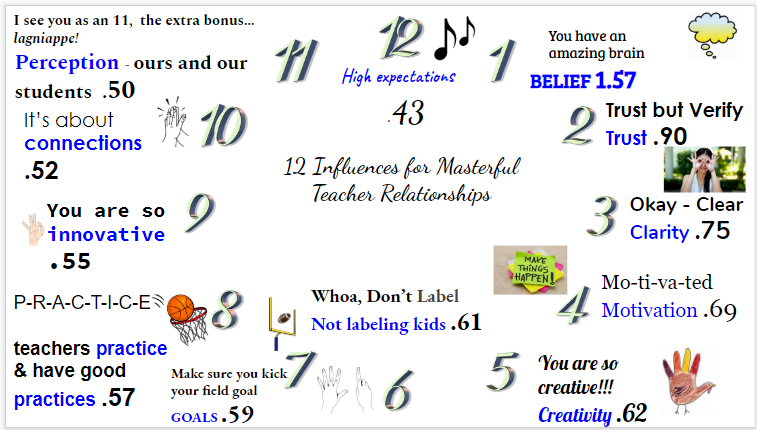
Below is the clock face strategy shared with you during August PD.  We didn't have the time to really model this strategy for you as it should have been. This modeling would have taken over an hour, I demonstrated it in less than 30 minutes.  What would have happened differently, would have been more recapping, going back to the different numbers and having you all standing up and teaching each other 1 -12 repeatedly, until you knew them.  Then, the next day, we would of practiced them again.  This strategy is a good one to use in your classroom if you have lists of items that need to be remembered.  The strategy works when it is chunked as it is taught, and recapped frequently with students saying and doing the motions.  It is a lot like a narrative chain (stay tuned), in that storytelling is used to help remember lots of information.  Clock face add numbers 1 - 12 to aid in retention.

What I really like about this clock-face, is all of the strategies mentioned are influenced by teacher actions and aid in development of teacher to student relationships.  Which we all know is the heart of learning.  

Stay tuned to next weeks blog, where we will dive into classroom management strategies.  

Wednesday, August 28, 2019

Welcome Fast Llamas


Bitmoji Image
Hello Fast Llamas!
Welcome to my strategies blog.  Here, strategies for classroom management, classroom culture, high expectations and instruction will be shared.
Each Sunday evening, I will be sharing a "Sunday Night Motivation" strategy with you.  Some of the strategies could be something new, something you can adapt, adopt or replace in your classroom.  Some of the strategies could be something that you have learned before, but, because we are all so busy, the strategy got lost in all the other things you had going on.  Sometimes, the strategy could affirm that you are already doing the best you can do your for students.  My hope is that you take something away each week.

I will be tapping into the expertise of Weston Kieschnick, Doug Curry, Todd Whitaker, Annette Breaux, George Lemov and of course John Hattie.  

To start out, I am sharing a picture from Doug Curry @fastllama.  
Here a teacher has left nothing to chance and her expectations and procedures are clear and explicit.  Now, this is an example of a 5th grade classroom, so ignore the cubby and other lining up procedures, but, the rest is good stuff.  Never underestimate a students knowledge of what success looks like.  Elementary teachers are masters at systems and so should middle school teachers.  The students are kids, just in bigger bodies.  Set students up for success by being clear of what is expected.  This teacher shares this with parents at Open House.  Parents want to help with behavior, so this gives them examples of language you use in class.  A win-win...
Stay tuned for more each Sunday!  Stay fast llamas!  Don't let the tigers get you!