Sunday, November 10, 2019

Student Discourse


Fast talking Llamas of Labay!


Today we are going to talk about increasing the ratio of student discourse and discussion in your classroom.  This is an important topic.  We want students participating in discussions and we want 100% of the students participating.  There are several strategies to help make this happen.  Doug Lemov uses a great saying in Chapter 9 of Teach Like a Champion, 2.0. he says that the "mental workout belongs to the students".  Today we will peruse increasing this workout using the strategies "Turn and Talk" and sentence starters (or sentence stems), then, we will talk about strategies to make this run smoother in your classroom.

Here are some things to think about.
1.  Have a vision about what Turn and Talk will look like in your classroom.  What are the fundamentals?  How will students be grouped or paired?  How will they sound, what is the acceptable volume?  What is the expectation for how students look at each other?
2.  Train the students and practice.  The first Turn and Talks might be messy, share your expectations and share with students what you expect it to look like and sound like.
3.  Timed or untimed?  Decide the timing.  You have choices to tell students that you are giving them 2 minutes to talk, or you can listen for when the crest of students voices occurs and call them back to your attention.
4.  If I haven't already shared this, tell your students exactly how Turn and Talk will look and sound like.  Will just one kid talk and the other listen?  Will both kids get a chance to talk?
         Example:
                1.  give each kid a letter, like A or B... A talks to be B, and B only listens, then switch next                       time.
                2.  give each kid a letter, like A or B, A talks to B and then B talks to A
                3.  be creative with kids, use different monikers
It's important to set students up for success and let them know your expectations, otherwise, they will just make up their own.
5.  Have a cue, the word "go" is very powerful to let students know when it is time to start.  It is quite simply saying, "When I say go, A's turn and talk to B's about the formation of igneous rocks for 27 seconds... Go!"
6.  How many of you have had to think about something complicated and it helped your thinking by writing it down?  You can level up the depth of the conversations, by having students down their thinking and then share what they wrote with one another in the Turn and Talk.
7.  Sentence stems and sentence starters.  If you choose to have students write first, consider using sentence stems.  Here is an example from 8th grade science:
I like it because is used visuals and tells students how to get started using the correct vocabulary.  This could be a turn and talk, or a write, then turn and talk.
8.  Have the students communicate with Complete Sentences.  This strategy comes from the book, 38 Great Academic Language Builders.  This allows students to practice using rigorous academic vocabulary.  The more they speak in complete sentences, the easier it becomes to write with complete sentences.  I love this thought, that students can write and then speak or speak and then write and it all helps students build their capacity in your subject area.  LOVE IT.
            Examples students can use to write and turn and talk.
                  The question... What are two characteristics of primary consumers?
                  The answer...  Two characteristics of primary consumers are....
 9.Cue for bringing the class back to whole group... How will you get the class back fast?
10.  What will you do with the information that was written and shared with partners? You can use sentence starters here too.  When you get students to share their discussions, stretch the whole group discussion by getting students to say, "I agree because or I disagree because, or I would like to add"

I think the biggest fear about allowing students to talk with one another is the fear that they students won't really talk about what they are supposed to talk about.  Heck, I have been in training when adults don't talk about what they are supposed to talk about.  So, frame your expectations, walk around and listen, be visible, frame the time students have, share examples of what you heard, celebrate when students do what is expected and finally have body language that shows you are rooting for students to have great shares (burning shares).
Clientmoji
Here are some video examples to watch...

Using a Sentence Starter:
Turn and Talk Techniques:

References:
Lemov, D. (2011). Teach like a champion: the complete handbook to master the art of teaching. San Francisco, CA: Jossey-Bass.

Seidlitz, J., & Kenfield, K. (2011). 38 Great academic language builders: activities for math, science, social studies, language arts... and just about everything. San Clemente, CA.: Seidlitz Education.

Lemov, D. (2011). Teach like a champion: the complete handbook to master the art of teaching. San Francisco, CA: Jossey-Bass.
Seidlitz, J., & Kenfield, K. (2011). 38 Great academic language builders: activities for math, science, social studies, language arts... and just about everything. San Clemente, CA.: Seidlitz Education.
Lemov, D. (2011). Teach like a champion: the complete handbook to master the art of teaching. San Francisco, CA: Jossey-Bass.
Seidlitz, J., & Kenfield, K. (2011). 38 Great academic language builders: activities for math, science, social studies, language arts... and just about everything. San Clemente, CA.: Seidlitz Education.

Lemov, D. (2011). Teach like a champion: the complete handbook to master the art of teaching. San Francisco, CA: Jossey-Bass.
Seidlitz, J., & Kenfield, K. (2011). 38 Great academic language builders: activities for math, science, social studies, language arts... and just about everything. San Clemente, CA.: Seidlitz Education.
Lemov, D. (2011). Teach like a champion: the complete handbook to master the art of teaching. San Francisco, CA: Jossey-Bass.
Seidlitz, J., & Kenfield, K. (2011). 38 Great academic language builders: activities for math, science, social studies, language arts... and just about everything. San Clemente, CA.: Seidlitz Education.
Lemov, D. (2011). Teach like a champion: the complete handbook to master the art of teaching. San Francisco, CA: Jossey-Bass.
Seidlitz, J., & Kenfield, K. (2011). 38 Great academic language builders: activities for math, science, social studies, language arts... and just about everything. San Clemente, CA.: Seidlitz Education.

Saturday, November 2, 2019

Using Call and Response the Fast Llama Way

Fast Llamas,

We continue our trek through strategies used to increase the ratio of student participation and thinking.  We want to collect data about student learning, at the same time, we are cognizant of which kids are doing the talking and the thinking.  Today we discuss , "Call and Response" from Doug Lemov's book, Teach Like a Champion, 2.o.  While I love his explanation, QL calls this technique a "Call Back".  Anytime I see a strategy in more than one place (different names, of course) I always get excited.  It sends a message that this is good pedagogy... lots of different people think it's good stuff, kind of affirms its strength as a strategy.  (I am always going to advocate for Quantum  Learning teaching practices, and since it has been around for such a long time... most strategies have roots in QL, it really is undeniable).
Now, I use a call to attention to get students to stop talking and listen, Call and Response is different, because it requires more cognitive work.  We will talk about call to attention later on...

Okay, so this is the strategy... While you are wanting to collect data from students about what they know... sometimes you want everyone to say the answer or reinforce a concept, vocab word or directive.  Use this from time to time to increase engagement, build energy and keep the students saying the words back to you.  This is especially good for introverted students, too afraid to speak up alone.  It also encourages fun, high energy and builds a classroom collective.  Added benefits also include the recapping it provides and that builds in muscle memory.  All really good culture builders for your room.  


Here's how it can look, sound and feel like:
1.  The teacher asks a question and the whole class responds in unison.  "Students, on three, tell me the name of the negative subatomic particle..."
2.  The students complete a familiar phrase, "Inside an atom...? [protons have a positive charge], Inside an atom [neutrons have no charge at all!]"
3.  The teacher gives a directive and the whole class responds in unison,  "Students, turn to page 33, what page? [33!]"
4.  The teacher asks a question, one kid answers it and then the whole class repeats the answer.  "What is the name of the neutral subatomic particle? Yes, Emma, it's a neutron.  Class, what is the name of the neutral subatomic particle? [the neutron!]"
5.  The teacher asks a question, one kid answers it and then the whole class agrees with the answer.  "What is the name of the neutral subatomic particle? Yes, Emma, it's a neutron.  Class, do you agree? [yes!] The name of the neutral subatomic particle is? [the neutron!]"
6.  The teacher says, "an electron is the negative subatomic particle"  Everyone, an electron is, [is a negative subatomic particle!]."  THEN, "Everyone,  a negative subatomic particle is? [an electron!]".  

An important thing to remember is setting students up for success for when it is okay to shout out together the answer and when it is not okay.  Also, you want everybody to say it in unison, so cue is needed. 
Here are some cue ideas:
1.  Count Based - just like it sounds, "Class, on three... tell me the answer"
2.  Group Prompt - using a specific word, "everybody, everyone, or class"
3.  Nonverbal - kind of like the one an umpire uses for a home run... 


Here's some examples in action:

  
Reference:
Lemov, D., & Atkins, N. (2015). Teach like a champion 2.0: 62 techniques that put students on the path to college. San Francisco: Jossey-Bass.

Sunday, October 27, 2019

Level Up our Cold Calling

Fast Llamas,

Today we pick up on the idea that Doug Lemov of Teach like a Champion, 2.0 refers to as "Ratio", the thinking  about the ratio of participation of your students and the thinking that is happening in your classroom.  As we intentionally think about transferring the cognitive load from us the teacher to the student, it can be challenging to think of how to get there.  Most of what Lemov describes has been around for a long time, but, it is always good to revisit good teaching techniques and refine our practices.  

Today, we talk about something really tricky.... t r i c k y...  Cold Call...  Anytime we call on kids, regardless of hands raised... when we use popsicle sticks or a randomizer... When students can be called on without volunteering...

It's tricky because using it incorrectly will damage your classroom culture... I mean it, it will ruin it, so tread carefully my friends, on this, the week of Halloween, using this technique is downright scary.  
Bitmoji Image


Let's look at what messages it sends when used incorrectly:
1.  it sends a message that learning is a "I caught you not paying attention" thing
2.  it sends a message that learning must be "fast paced"
3.  it sends a message that learning is punitive
4.  it can discourage participation
5.  it can increase anxiety with fragile students

Okay, so why bother?  Well, we want to instill a culture of high participation and engagement.  We want students to be accountable for their own learning and carry the workload, so cold calling does have a place in your classroom, but, use it in conjunction with Turn and Talk, Think Time and Wait Time to be most effective.  Our job as teachers to is to set up students for success and we do this when students know what to expect and have time to think.  It is is rewarded with food feelings about learning.  (dopamine washes across the brain, this is a good thing)

Here are some things to put into play when using Cold Calling:
1.  Keep it predictable and transparent - tell students when you are going to use it.  By doing this you setting them up for the high expectations.  Let them get ready.  Use a cue, when you say, for example, "solve this using mental math", or think about this "deeply"... this sends a message that cold calling is about to happen...
2.  Keep it systematic - don't spring it on the class when you feel they are not paying attention.  It is a time for students to show you what they know, not a time for punishing a kid who is goofing off.
3.  Keep it positive - you are rooting for their success and your body language shows it... some kids don't know what they know... getting them to talk about what they know can be surprising, allow students to show thumbs up when they have it... giving them time to be prepared... 
4.  Bundle - ask questions that build on one another, one kid's answer supports they next question you ask, this supports a kind of "group think", where kids are supporting each other with their answers
5.  Pacing - who said the questions have to be "rapid fired?"  keep the pace slow and even, so that students have a chance to think... or talk about their thinking with peers, or script our their answer first...  Also, ask the question, pause, then call the name... this builds anticipation... great for feeding the hippocampus and calming the amygdala of the brain.
6.  Plan ahead - plan out when you will use Cold Call in your lessons, being purposeful in collecting data

Here are some examples:


References: 

Lemov, D. (2015). Teach like a champion 2.0: 62 techniques that put students on the path to college. San Francisco: Jossey-Bass.


Sunday, October 20, 2019

Fast Llamas: Teaching Our Students How to Think

Fast Llamas,

Over the next couple of weeks, we will be talking about what Doug Lemov of Teach like a Champion, 2.0 refers to as "Ratio".  This is thinking intentionally about the ratio of participation of your students and the thinking that is happening in your classroom. Think of participation ratio as the engagement of the students and think ratio as the rigor of your lessons.  It's always a good thing when we purposely plan for the kids in class to carry the cognitive workload.  They should be the ones working harder than you!  They should be the ones writing, thinking, talking & analyzing.  This idea is the brainchild of KIPP schools founder David Levin and when you think about it, is what skilled teaching is all about.  
The question is... if we know students should be answering questions, talking about their learning with each other and writing critically, how can we get there?  What strategies can we use to stop being the 'sage on the stage?'  How do we ensure that our questions aren't engaging 5 students and the rest passively watch and play along?  

Let's start with the question technique called Wait Time.  Using Wait Time as an intentional technique raises both the participation ratio and the think ratio.  Your most likely to get better answers from more students... brilliant.

Do you think that you are modeling "how" to think when you encourage time to think?  I'll wait...
Clientmoji
If you answered yes, then you are on the right track.   A big part of our job as teachers is teaching thinking skills as we teach our content.  What a tremendous gift to to give our students.  
Wait Time - wait what?  That old thing?  Yes, that old thing... I was introduced to this idea in my Methods Course at TTU in the 80's (well, 1989, but still ) & that means it's been around a loooonnng time...   Which means you know about it too... the idea here is to level up and refine the practice.  

Here are some ideas to use Wait Time effectively:
1.  Practice using it actively... Count in your head if needed
2. Narrate to students the amount of time you will give them... "I'll give you 6 seconds to think about it, then raise your hands"
3. Do not accept "shout outs"... this will take some work if you have allowed it... talk to kids about the change in strategy and stick to it
4.  Narrate hands raised... "I see one hand up, I see three hands, I see 6 hands, waiting to see 10"  if you have created a culture of high expectations and safety, you will get the hands raised
5.  If you still get crickets and very few hands raised... allow and encourage students to use their notes... (because reading is thinking too)
6.  Affirm to students what to do with the time... show them what it means to think, say things like,"The six seconds I gave you is over, but, I see people still jotting down ideas and reading, I'll give everyone more time",  "I see people using their notes, this is a good idea", " I want you to think deeply on this question, so think before you raise your hand"
7.  Stop Talking - be careful with your affirmations and that you actually give students silence to think.  So, d0n't affirm the entire time... say it quick and then stop talking.
8.  Show students what successful thinking looks like... preface your questions when they require details and deep thinking by telling students what you expect out of the answer.  For example, you could ask, "What is the a chemical change?" or you could be explicit with expectations and say, "this question requires some examples, be sure to refer to your notes to backup your answer"

Here are some clips in action...


References: 

Lemov, D. (2015). Teach like a champion 2.0: 62 techniques that put students on the path to college. San Francisco: Jossey-Bass.

Sunday, October 13, 2019

Fast Llamas Know Their Why


Fast Llamas,

I love this video, Percy and I showed it to students last year when we taught them the 8 Keys of Excellence and the Line... I hope you love it too.  It shows the importance of knowing your "Why".
Knowing your why is a reflective practice that can really change the game for us as educators. Over the weekend, I saw two meme's that stuck with me.  One talked about the need to stop thinking that teachers need to be "fixed", instead, they should be supported, encouraged, inspired and appreciated. Dr. Brad Johnson (who wrote the meme) is an author of several books, including Learning on Your Feet: Incorporating Physical Activity into the K-8 Classroom (this sounds interesting), & What Schools Don't Teach: 20 Ways to Help Students Excel in School and in Life.  Dr. Johnson"s latest book, Putting Teacher's First co-authored with Todd Whitaker was just released.  His twitter page is worth following as is Todd Whitaker (more from him in a second). 
   

I love these as they are foundational beliefs for me.  Wes Kieschnick talks about the need to stop saying that education is broken. In both his Models Schools Conference Keynote speech and his book, Bold School, he is passionate to say that public education is not broken.  
Teachers have the ability to move mountains with kids, but, we have to work together, support one another and help one another.  The fast llama herd is there to support each other when we slow down.  Not only do we support each other when we feel slow, but, we also are there to celebrate the victories too.  This goes along with John Hattie's finding in his research that the number one strategy to move the needle, affect change and growth in students with the idea of the Collective Teacher Efficacy fed by the knowledge of their impact in schools.  The collective knowledge and skills present at Labay is amazing and excellence is all around us.  Hattie stresses the idea of "know they impact".  
Teaching is important and no program is more important than the teacher.  It's about people, not programs and the best PD can often be the teacher down the hall.  And we should lean on and rely on each other for assistance, collaboration and moral support as much and as often as possible.  We share our expertise with one another, know our impact and change the learning lives of our students.
I am reading the book, 75 Ways to Be a Better Teacher Tomorrow by Annette Breaux and Todd Whitaker.  This book was handed out to new teachers and it is a quick read with each chapter 2 - 3 pages.  Today, I am focusing on idea #15, Post a Simple Sign Telling Why You're a Teacher.  Andy Abbott and I were talking about this the other day, low and behold, it's already a thing...

It looks, sounds and feels like this... 

Make a sign that says, "I'm a teacher because..." and then list the reasons.
Make the sign fairly large and post it in the room for all to see.  It will remind you, every day, of why you are here and why you do what you do. 
Here's an example from the book:

I am a Teacher Because...
1.  I love my students.
2.  I love to help people achieve their goals.
3.  I believe that all of my students are talented.  It is a privilege to help students   
     discover their unique talents
4.  I believe that all of my students have amazing potential. It is a privilege to help all 
     students realize their potential.
5.  I feel there is no more important profession in the world.
6.  I love learning from my students.
7.  Teaching is fun for me!

Consider placing a duplicate sign outside your door.   I am thinking this would be a great addition to our teacher Bio's we already have posted.  Others will stop by and read it and you will inspire others.  Administrators will read it as well as well as guests in our building.  Proudly proclaim your love of teaching and post it for all to see.  

We are shifting our mindset in our thinking. This takes effort.  Everytime we send a positive thought across our neural pathways, we make our positive thoughts and actions stronger and stronger.  This thinking creates real change.  The first step is belief.


References:

Breaux, A. L., & Whitaker, T. (2019). 75 Ways to be a better teacher tomorrow: with less stress and quick success. New York: Routledge.
By. (n.d.). John Hattie. Retrieved from https://visible-learning.org/john-hattie/.
Kieschnick, W., & Casap, J. (2017). Bold school: old school wisdom new school technologies = blended learning that works. Rexford, NY: International Center for Leadership in Education.
Breaux, A. L., & Whitaker, T. (2019). 75 Ways to Be a Better Teacher Tomorrow: with Less Stress and Quick Success. New York: Routledge.By. (n.d.). 

John Hattie. Retrieved from https://visible-learning.org/john-hattie/.Kieschnick, W., & Casap, J. (2017). 

Bold school: Old School Wisdom + New School Technologies = Blended Learning that Works. Rexford, NY: International Center for Leadership in Education.

Breaux, A. L., & Whitaker, T. (2019). 75 Ways to be a better teacher tomorrow: with less stress and quick success. New York: Routledge.
By. (n.d.). John Hattie. Retrieved from https://visible-learning.org/john-hattie/.
Kieschnick, W., & Casap, J. (2017). Bold school: old school wisdom new school technologies = blended learning that works. Rexford, NY: International Center for Leadership in Education.

Sunday, October 6, 2019

Level up Planning - The Fast Llama Way


Fast Llama's,

Is it me or is the school year flying by?  We are heading into DPM time already!  
This past week I got a pedagogical infusion with face to face training with Pete Hall.  If you ever have an opportunity to hear him, he is simply amazing, real and intentional.  He got me thinking about planning and the "thinking about the doing".  This is an important moment for me as I have been struggling with the backwards planning process that Donna Pahmiyer advocates.  Her process is a good one, very intentional and grounded in the research.  (backwards planning shows up in the literature a lot, trust me).  
When the science department was spoiled with what we called the "war room", a room completely ours for planning, the process worked really well.  However, that room is gone and I tried and (have failed) to continue the process with large paper and markers... it was a whole thing.  We always try to bring our best and have the best intentions, but, physically it became impossible. However, what we learned from the backwards planning process (after reflection, more on this in a minute), is:

1. it's important to know what mastery and success looks like
2. it's important to know what the TEKS really say and what experiences students have with them
3. it's important to know what we are teaching everyday and how it aligns to what is assessed
4.  it's not teaching to the test when we are intentional to the exposure students are getting daily (this was the toughest one to accept)
5.  planning is important because it allows us to think deeper about the learning and most importantly, about the doing

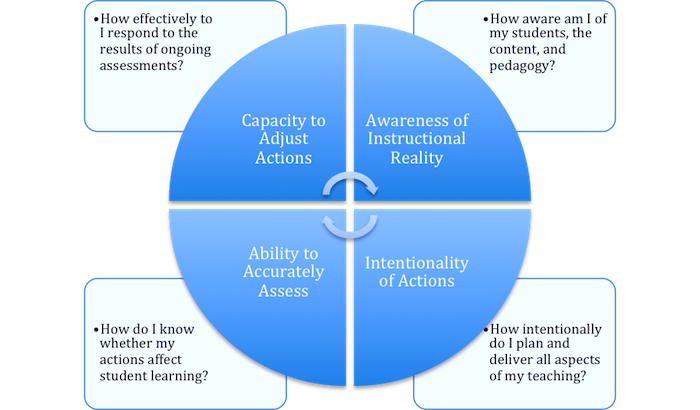
One of my favorite colleagues to discuss "the work" with is Melissa Bustos.  I do believe I like talking with her about teaching practices because she is reflective.  John Dewey (our old friend) said, "We do not learn from experience... we learn from reflecting on experience.”  And reflecting on our teaching practice is extremely important and what separates, what Pete Hall calls the "unaware", "conscious", & "action" teacher to the "refined" teacher on his reflective continuum.  (Unaware just means you don't know, it doesn't mean you are incapable of knowing, for example, I am unaware about how to artfully carve a pumpkin, but I can learn and practice and perhaps become an expert if I put in effort to the task) 

Here is Hall's Reflective Cycle:  


"If you don’t think, you don’t learn. It is the ongoing reflection by a teacher about their practice that results in improvement. Teachers who don’t regularly reflect risk stagnation and thus miss opportunities to engage and teach their students at higher levels." David Perkins.  
https://aplusala.org/best-practices-center/2018/12/14/helping-teachers-at-every-stage-build-their-capacity-to-reflect/

On Friday, Melissa and I hashed out a new plan to put Pahmiyer's  training into place in more intentional and practical ways that work for us at Labay.  "Her ideas are good, I get it", Melissa said, telling the first year teacher on our team, "you are learning a lot today."  
It's the planning that is the real work.  Teaching is actually quite easy, it's figuring out what to say, what to do, how to assess, how to dive deeper, how to extend, how to teach success, etc., that makes the work we do both rewarding and exhausting.  This reflection and planning is what separates excellence with mediocrity. 

So, my strategy to offer to you for tonight's motivation is to put reflection into practice.  Start a reflective journal on your teaching practices, like the one I created when I was starting with more purpose and intentionality using Quantum Learning strategies.  I wrote each day on the "QL" strategies I was putting in to play in my lesson plans.  The planning morphed into using my content to provide SEL, multicultural and character lessons into my daily interactions with students.  Reflective journaling made the difference that year in  my growth of putting into play more QL.  Teaching became exciting as I was looking for ways to level up my lessons.  It took a little effort, but the pay off was big.  I didn't realize it at the time that I was being reflective, I was simply writing down what I was doing to think about new ideas and realistically to remember to do it again the next year.  It was the difference between mediocrity and what I might dare say excellence.  


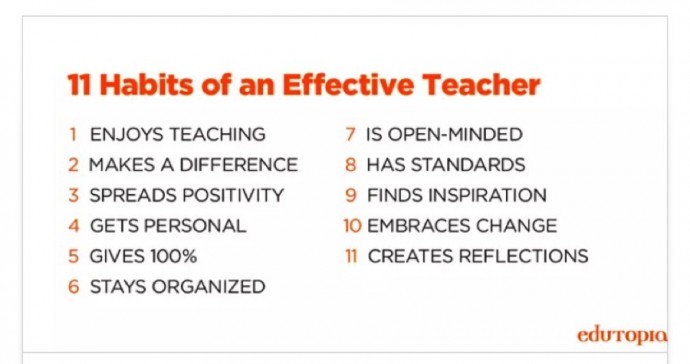
I found this on Edutopia, let's rename this 11 Habits of a Fast Llama! Check out #11.  


Keep running fast llamas!
For more information about Pete Hall research, check out this presentation...
https://www.sccharterschools.org/assets/2016Conference/growingyourreflectionprocess.pdf

Pete's Books: